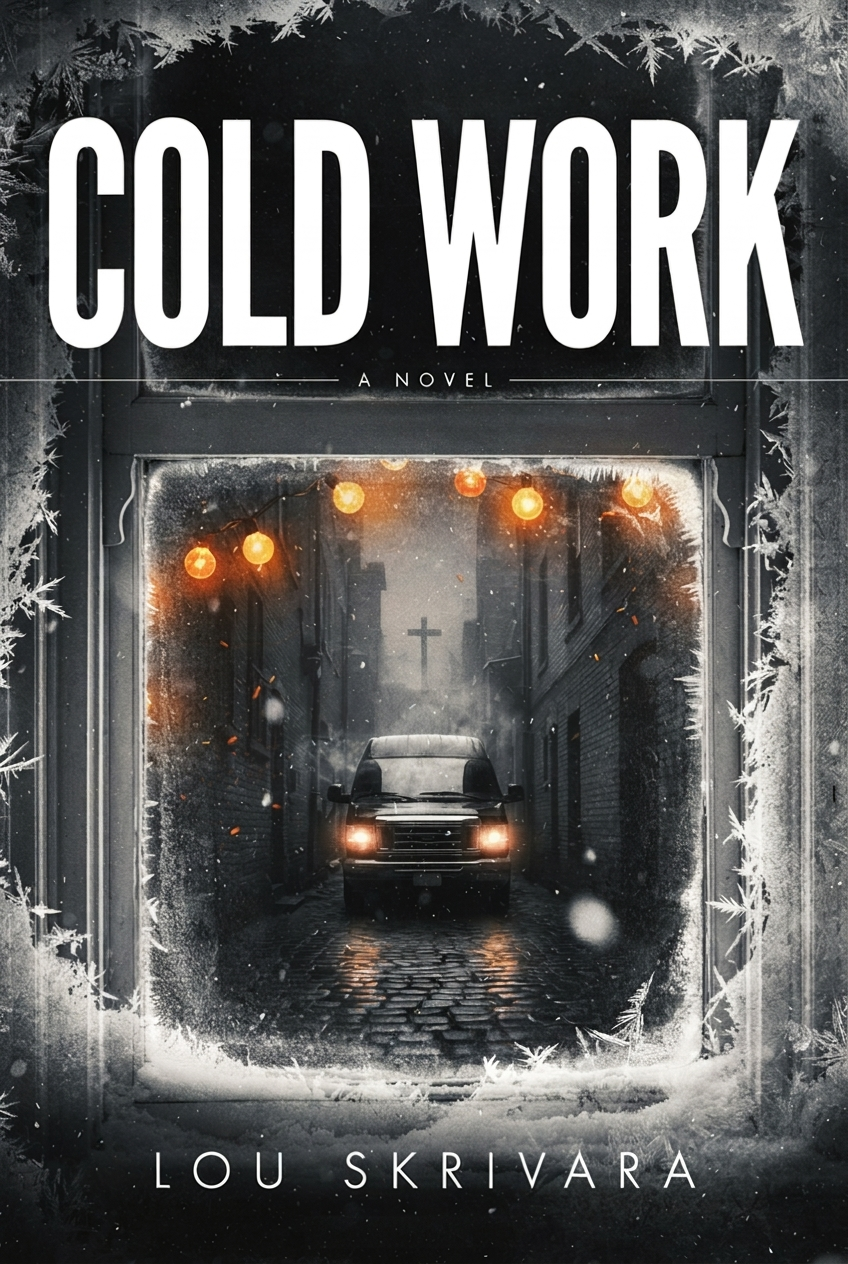
Case file Lou Skrivara
Cold Work
"The Wire" meets "No Country for Old Men." A wounded mob captain and two women who read people for a living take on a trafficker who can't be threatened, bribed, or broken — because he's the one man in the city who wants nothing at all.
The knock comes at five-forty on a December morning. An old man from Sobieski Street, cap in both hands, asking about the green house at the end of his block — the one nobody lives in, where a van backs into the drive at three a.m. with the lights off.
Freddy Stopiak is the West Side's other law, the man a parish neighborhood goes to when the first law is bought. He is two weeks into holding what's left of the old council, in a Rust Belt city already down to its last good streets, when the old man's question lands in his hands — and stays there.
The answer is worse than drugs. The green house belongs to a trade that moves people like freight, run from the south of the city by Micky Pays: a man with no club, no church, no photograph on any wall. Only a bookkeeper, a ledger, and a patient arithmetic that prices everything Freddy was raised to protect.
The rules say the South side is not Freddy's to touch. Freddy touches it anyway. And as the Wigilia lights go up in the parish windows, a wounded captain, a fixer spending debts she can't recover, and a woman who reads rooms for a living — and has just broken her own first rule — are all that stand between the neighborhood and the men who count it.
Cold Work is the second Moldeth City novel — a literary crime saga of old codes, new predators, and a neighborhood worth bleeding for. It stands fully on its own. For readers of Dennis Lehane, S.A. Cosby, and George Pelecanos.